DACF Home → Bureaus & Programs → Maine Forest Service → Forest Health & Monitoring → Invasive Threats to Maine's Forests and Tree → Browntail Moth Euproctis chrysorrhoea
Browntail Moth - Euproctis chrysorrhoea (L.)

On this Page:
- FAQs
- News & Events
- General Information
- Management Techniques
- Where is Browntail Moth?
- For Towns & Businesses
- Research
Frequently Asked Questions
Partners at Maine Forest Service, Maine Board of Pesticides Control, Maine Center for Disease Control, Cooperative Extension and others have put together an extensive list of frequently asked questions. Questions cover topics from biology, to management, to policy to pets.
How do I avoid exposure to the browntail moth toxic hairs? +
- When working in heavily infested areas, wear proper protective equipment to reduce exposure including:
- Long sleeves
- Long pants
- Goggles
- Dust mask/respirator
- Hat
- Disposable coveralls
- Avoid heavily infested areas between April and August, don't use leaf blowers or lawnmowers on dry days in these areas
- Using pre-contact poison ivy wipes can help minimize hairs sticking into exposed skin
- Do yardwork on wet days, which decreases the likelihood that the hairs will become airborne.
- Make sure to use a HEPA filter on a wet/dry vacuum to decrease the likelihood that the hairs will become airborne.
- Do not dry laundry outside in infested areas.
Close -
When do browntail moth adults fly? +
- Adults emerge in July and are flying through August. Peak activity around lights at night is between 10 pm and 12 am.
Close -
Do the browntail moths also have toxic hairs like the caterpillar? +
- There is a possibility of adult moths picking up the toxic hairs from the caterpillar stage as the moths emerge from their cocoons; however, the brown hairs on the abdomen are not the toxic hairs.
- The caterpillars, pupal cocoons, and shed skins have the toxic hairs that can cause a skin rash.
- The hairs on the adult moths are not toxic and do not cause a skin rash.
Close -
How can I get rid of browntail moth adults? +
- A wet/dry vacuum with a HEPA filter and filled with a few inches of soapy water.
- Keep outdoor lights off at night during the last week of June to the first week in August
Close -
Does killing browntail moth adults (moths) help with management? +
- Moths found on buildings and in light traps are primarily males. Killing males is unlikely to reduce the next generation of browntail moth.
- Using a bug-zapper or other device to kill insects attracted to lights is not recommended. It will kill insects that might help control browntail moth and other pests as well as browntail moths. It will also attract more browntail moths to the area. Females attracted to an area by lights tend to hang out in host tree foliage and are not captured in high numbers with these methods.
Close -
All Frequently Asked Questions

News
Browntail Moth Update #9: August 26, 2026
In August, browntail moth caterpillars hatch from their egg masses and begin feeding on the late summer host foliage. Browntail egg masses are small, hairy, and light tan in color and are typically found on the underside of oak, apple, cherry, elm, birch, and other hardwood host leaves.
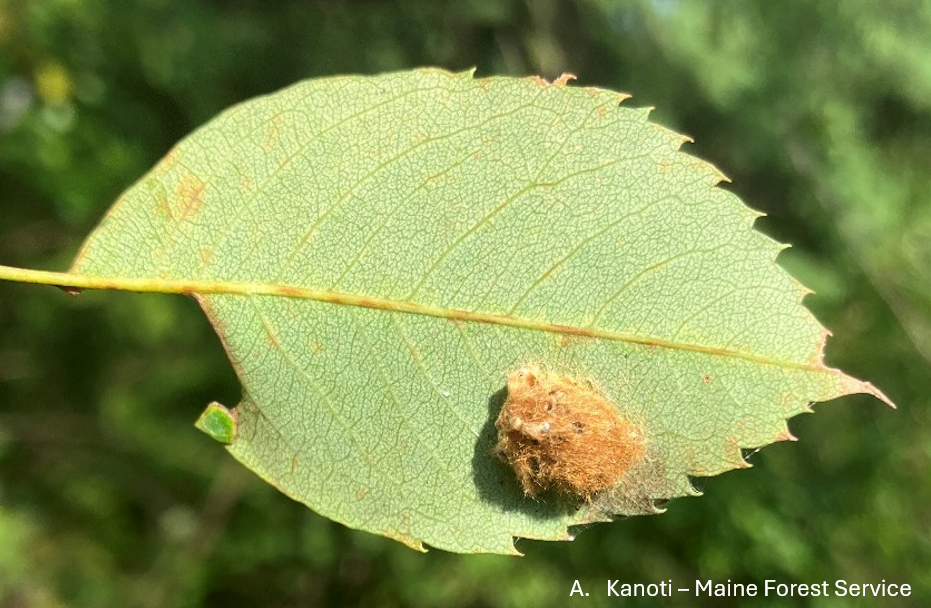
Newly emerged browntail caterpillars are too small to eat all parts of the late summer leaves, so they graze only the outer surface, leaving behind the leaf skeleton. Over time, this process of skeletonization causes the leaf to die and turn a copper color – a clue we use to help narrow down which defoliator is causing the damage in late summer.
In most areas of the state with recent browntail moth populations, egg masses are difficult to spot. You may need to wait until late autumn, after the winter webs tighten up, to get a good understanding of the potential browntail moth impact next spring.
Large webs in late summer: Is it browntail moth?
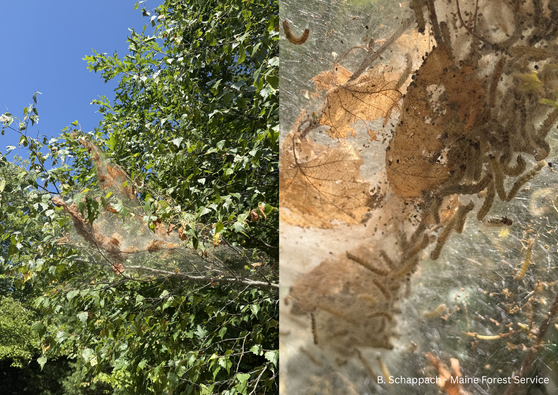
Over the past month, we have received many reports of large webs in the trees. Most commonly, webs larger than a football in late summer are created by a native caterpillar, fall webworm (Hyphantria cunea) and are not created by browntail caterpillars.
While these fall webworm caterpillars can create webs that get very large - sometimes covering an entire tree - they are not a forest health concern and do not cause a rash in humans. At most, their webs can be unsightly for a couple months until they naturally break down in the winter season.
If you see webs in your trees in late summer and want to know how to tell the difference, consider:
- Does the web cover entire branches, or sometimes the whole tree?
- Are there large (greater than 1 inch long), hairy, yellowish-brown bodied caterpillars crawling on or inside the web?
--> If so, you are likely looking at native fall webworm caterpillars. Celebrate their success and leave them be with the knowledge that they are a great food source for birds and are described as "parasitoid hotels" in Wagner's Caterpillars of Eastern North America guide (2005), which help support other beneficial insects in our forests.
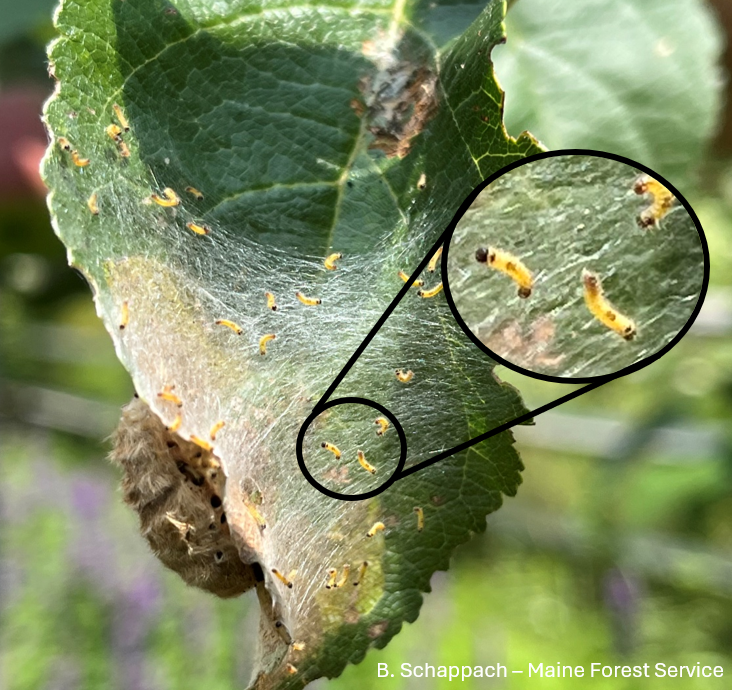
But, if the web:
- Is only the size of your palm,
- Has silken pathways leading up the branch,
- Has small (~less than 1/2 inch long) pale yellow caterpillars with a black head and two dark spots near its head,
--> You are likely looking at non-native browntail moth caterpillars. Although it is too late for effective management in the late summer, make a plan to monitor these webs and remove them in the winter season to reduce browntail moth populations on your property. Read our Browntail Moth Brochure for tips on how to recognize and remove winter webs.
Tips for preventing the rash this fall
As we transition from summer to autumn, fallen leaves may harbor toxic browntail moth hairs and cause a rash. If you've had browntail caterpillars on your property in the last 3 years, their hairs may be lingering.
During fall leaf clean-up:
- Wear protective gear to reduce exposure to hairs: long sleeves, long pants, socks, closed-toed shoes. Goggles and a mask may also be helpful.
- Perform yardwork on wet days, or early in the morning to decrease the likelihood of the hairs getting stirred up.
- Shower after being outside to rinse off any hairs that may have settled on your skin.
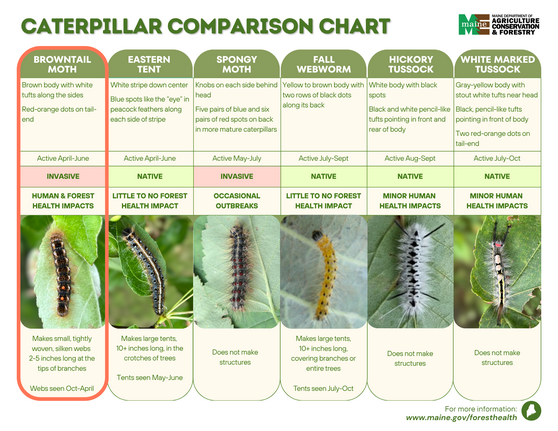
Check out our new Maine caterpillar chart!
Maine is home to many different species of caterpillars seen each spring, summer, and autumn. This chart can help you distinguish some of the species most commonly mistaken for browntail moth caterpillars and when you may see their webs and tents in your trees.
Sign up for our Conditions Report to stay up to date on other insect and disease topics!
More Browntail Moth News Updates +
Close -
Events
- No events currently scheduled.
General Information
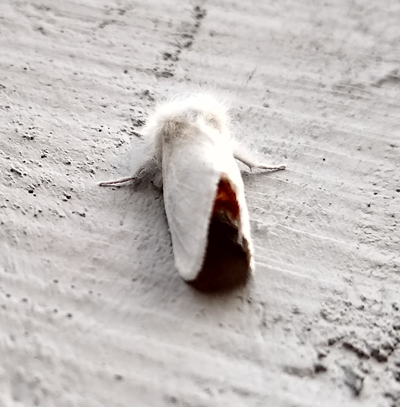 The browntail moth is an insect of forest and human health concern which was accidently introduced into Somerville, Massachusetts from Europe in 1897. By 1913, the insect had spread to all of the New England states and New Brunswick and Nova Scotia. Since that time, populations of this pest slowly decreased due to natural controls until the 1960's, when browntail moth was limited to Cape Cod and a few islands off the Maine coast in Casco Bay. Browntail moth populations are again building in Maine and are found in patches along the coast and up to 60 miles inland from the western Maine border to the New Brunswick border, with the greatest concentrations in mid-coastal Maine and the capital region.
The larval stage (caterpillar) of this insect feeds on the foliage of hardwood trees and shrubs including: oak, shadbush, apple, cherry, beach plum, and rugosa rose. Larval feeding causes reduction of growth and occasional mortality of valued trees and shrubs. Learn More: How to Identify Maine’s Main Defoliating Caterpillars (YouTube) / Life Cycle of Browntail Moth (PDF)
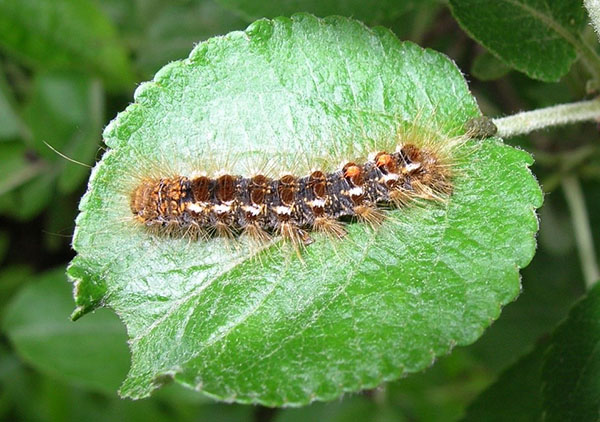
While feeding damage may cause some concern, the primary impact on humans by browntail moth results from contact with poisonous hairs produced by the caterpillars. Microscopic, toxic hairs break off the caterpillars and can be airborne or settled on surfaces in browntail moth infested areas. Sensitive individuals who encounter the hairs may develop a skin rash similar to poison ivy and/or trouble breathing. Symptoms can last anywhere from a few hours to several weeks and can be severe in some individuals. Learn More: Maine CDC Browntail Moth Information
Management Techniques
Focus management on populations that will directly impact people, pets and livestock or pose a high risk of contributing to spread.
For Smaller Trees & Shrubs +
Browntail web removal: Webs in small trees and shrubs, safely within reach of the ground, and without hazards such as powerlines, can be removed between October and March. Browntail caterpillars emerge from their webs and begin feeding in mid-April, therefore webs removed after this time will not contain caterpillars and not be effective. Destroy webs once removed (burn, soak for an extended period in soapy water, or dispose of in trash). With permission, you can do this on properties you don’t own or manage. If there are hazards, or you need to leave the ground, this is work for a licensed arborist.
Use extreme caution if burning webs. Never burn unless the branches have been clipped off. This type of burning requires a burn permit. For more information, please visit www.maineburnpermit.com and check the daily forest fire danger report.
Browntail caterpillar treatment: Pesticide applications are most effective for browntail caterpillars when the pesticide product can take effect before late May. Treatments after that time are not recommended and are not part of an effective integrated approach to management (or IPM strategy). Since caterpillars are already wandering to new locations, targeted applications are not possible. Further, pesticide applications at this time of year are more likely to impact other living species in your trees, including pollinators and native insects, without effectively reducing the impacts from browntail. At this time, there are many shed caterpillar skins and toxic hairs that have already built up in the environment. To have more effective control of browntail, plan to target the next generation of caterpillars by scouting out new winter webs this winter to determine which trees you may want to treat next spring
Applications must be consistent with the label directions. Consider hiring a licensed pesticide applicator. In most years, treatment should be effective (caterpillars killed) before late May. Later treatments do little to reduce both hairs in the environment and damage to hosts.
If you are managing browntail moth using pesticides within 250 feet of the mean high tide mark adjacent to coastal waters and extending upriver or upstream to the first bridge, additional rules apply.
If you are unlicensed, do not use this approach on properties that are not yours or are open to the public.
Close -
For Webs in Taller Trees +
Hire professional help to treat webs out of reach or near hazards on the property you own or manage. Line up help during fall or winter.
Licensed Professional Arborists can remove BTM webs in larger trees and shrubs (October to March).
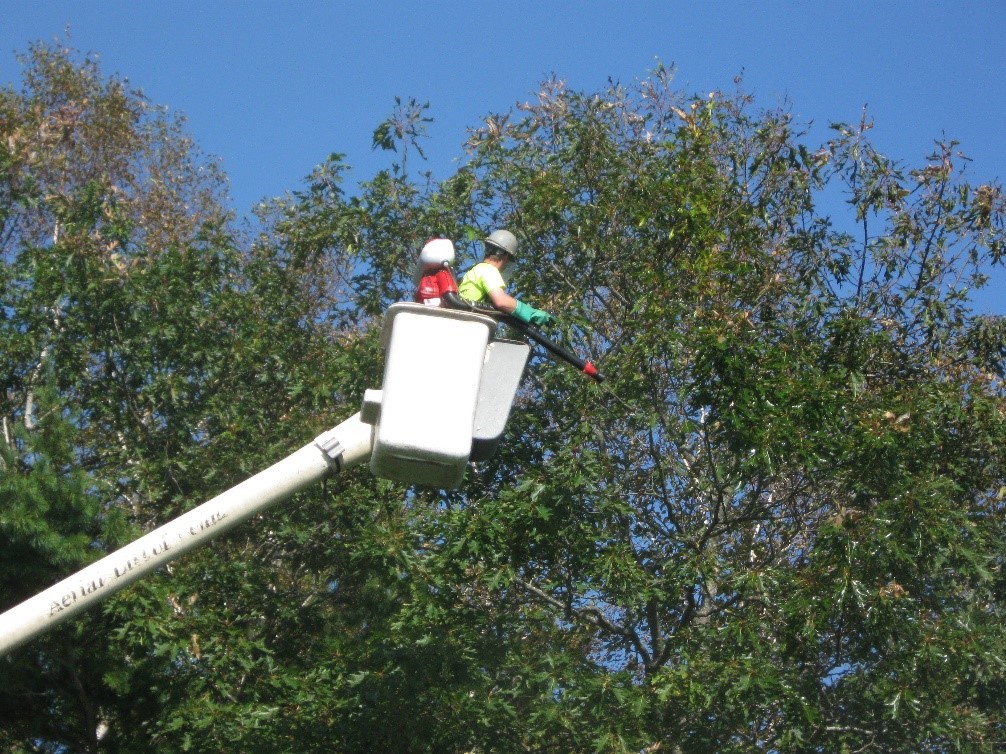
Unmanned Aerial Vehicle (UAV) Operators with an FAA Remote Pilot License may provide services using UAVs with attachments that physically remove webs.There is no requirement that these operators have knowledge of tree care. As in working with any professional, confirm your prospective contractor is adequately insured and qualified to provide the service.
- Licensed Pesticide Applicators willing to treat Browntail Moth, Hemlock Woolly adelgid and/or Other Pests
- Licensed Drone Operators (PDF)
- Arborists willing to PRUNE browntail webs in the winter (PDF)
For large trees, there are very limited insecticidal products (PDF) that are readily available to and applied by unlicensed individuals and that can legally be applied to target trees and life stages of browntail moth.** In trees where the caterpillars' hairs cause a nuisance and where it is not practical to remove the webs, Licensed Pesticide Applicators may be able to use insecticides during the growing season to manage BTM.
**Acecaps are not registered for use in Maine because the label does not meet federal standards for pesticide labeling. It is therefore not legal to use Acecaps. The Maine Board of Pesticides Control has provided support to the manufacturer to explain what needs to be changed to come into compliance and encouraged the manufacturer to work with EPA to bring their label up to standards. If we become aware of a change in status, we will update this message. You can check the current registration status by entering the product name in this database.**
Close -
Where is Browntail Moth in Maine?
Maine Forest Service conducts surveys for browntail moth from small planes and from moving trucks. These are broad-scale surveys that do not completely cover the impacted area. You can get a broad idea of where browntail moth is in Maine from our interactive map, just updated with 2025 winter web surveys. To understand what browntail moth is up to in a specific area, take a look at host plants for webs and signs of caterpillar activity.
Browntail Moth Interactive Map
Citizen Science Survey Protocol
Aerial Detection Survey Maps +
- 2025 Browntail Moth Aerial Detection Survey (PDF)
- 2024 Browntail Moth Aerial Detection Survey (PDF)
- 2023 Browntail Moth Aerial Detection Survey (PDF)
- 2022 Browntail Moth Aerial Detection Survey (PDF)
- 2021 Browntail Moth Damage Survey (with 2020-2021 Winter Web Survey data) (PDF)
- 2020 Browntail Moth Aerial Detection Survey (PDF)
- 2019 Browntail Moth Aerial Detection Survey (PDF)
Close -
Winter Web Survey Maps +
- 2026 Browntail Moth Winter Web Moth Survey (5.18 MB | PDF)
- 2025 Browntail Moth Winter Web Moth Survey (5.18 MB | PDF)
- 2024 Browntail Moth Winter Web Moth Survey (8.86 MB | PDF)
- 2023 Browntail Moth Winter Web Moth Survey (3.23 MB | PDF)
- 2022 Browntail Moth Winter Web Moth Survey (2.97 MB | PDF)
- 2021 Browntail Moth Winter Web Moth Survey (PDF)
- 2020 Browntail Moth Winter Web Moth Survey (1.11 MB | PDF)
- Maine Browntail Moth Roadside Population Assessment: Winter 2018 (PDF)
Close -
For Towns and Organizations
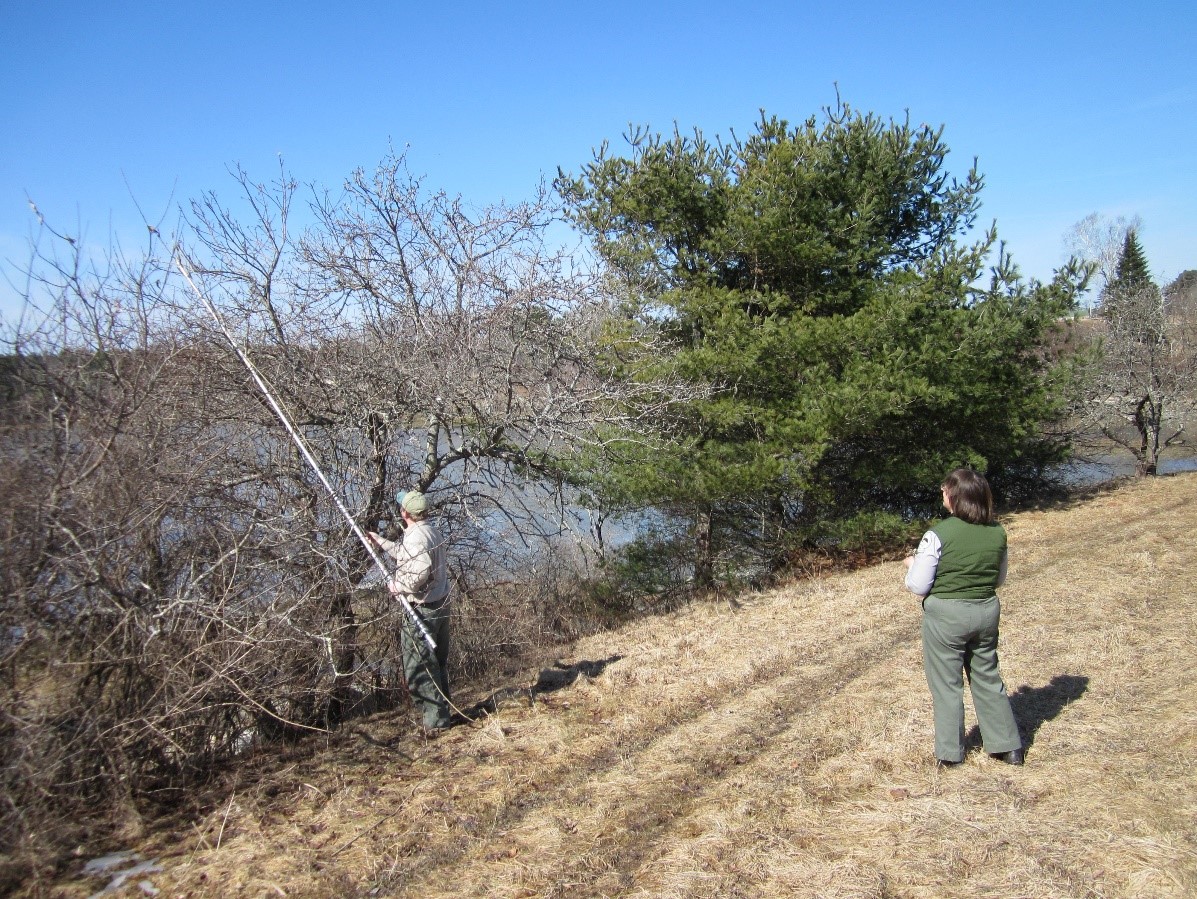
Focus management on populations that will directly impact people, pets and livestock or pose a high risk of contributing to spread.
- Management Overview for Towns and Organizations (‘Municipal Battle Book’)
- Frequently Asked Questions
- An interactive map with the latest updated survey data
- Browntail Moth Videos
Hire professional help to treat webs out of reach or near hazards on the property you own or manage. Line up help during fall or winter.
- Licensed Pesticide Applicators willing to treat Browntail Moth, Hemlock Woolly adelgid and/or Other Pests
- Arborists willing to PRUNE browntail webs in the winter (PDF | 340MB)
Social Media Toolkit +
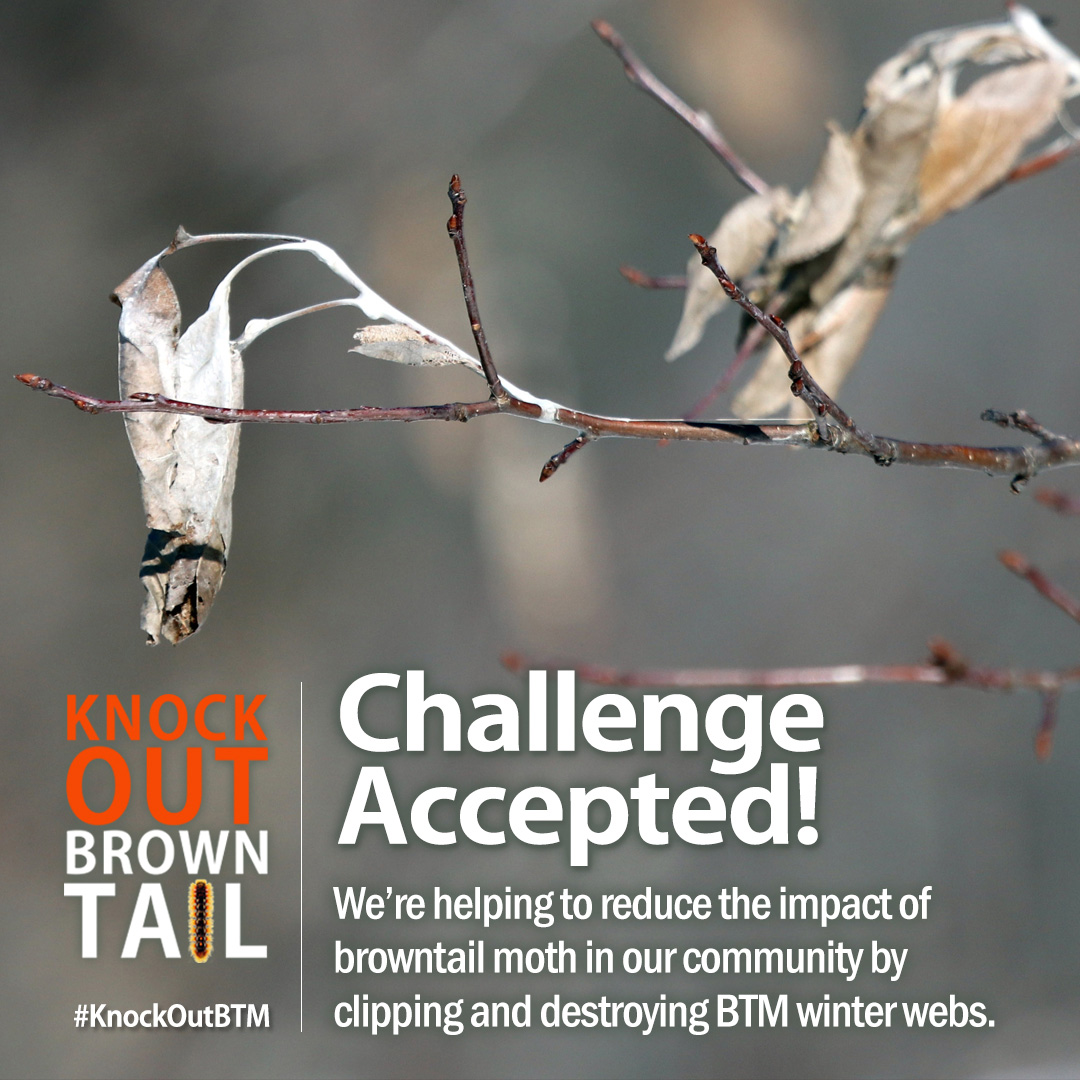
#KnockOutBrowntail Business Challenge +
Research
Entomologists with the Maine Forest Service in the Department of Agriculture, Conservation and Forestry (DACF) have teamed up with the University of Maine to track the spread and investigate the causes of the outbreak and evaluate management strategies for this daunting pest.
- Research Regarding Browntail Moth’s Attraction to Artificial Light, UMaine’s Forest Entomology Lab Aims to Reduce the Public’s Risk of Getting the Browntail Moth Rash (PDF)
- 2025: Parasitoids Attacking the Browntail Moth, Euproctis chrysorrhoea (Lepidoptera: Erebidae), During a Regional Outbreak in Maine, and Factors Influencing Their Abundance
- Evaluation of Biorational Insecticides for Management of Euproctis chrysorrhoea (Lepidoptera: Erebidae) | Journal of Economic Entomology | Oxford Academic (oup.com)
- Karla Boyd, Francis Drummond,Charlene Donahue, and Eleanor Groden; 2021: Factors Influencing the Population Fluctuations of Euproctis chrysorrhoea (Lepidoptera: Erebidae) in Maine (PDF)
- Karla Boyd’s 2020 thesis: "The Relative Abundance and Diversity of Parasitoids of the Browntail Moth (Euproctis chrysorrhoea L.) and Factors that Influence Their Population Dynamics"
- 2020 Summary of Research at the University of Maine (PDF | 1.49 MB), 2022 Update (PDF)
Click the images below for larger shareable graphics perfect for use on social media or Download All Graphics
Got questions about browntail moth? 211 is there to answer them.
Know your enemy and your friends. #KnockOutBTM, not silkmoths.
Image credits: DACF except promethea larva BOMONA user Zelenaks, promethea adult BOMANA user JRTindall
Learn how you can #KnockOutBTM and reduce the itch at www.maine.gov/dacf/knockoutbtm.
“browntail” in brown font
Learn how you can #KnockOutBTM and reduce the itch at www.maine.gov/dacf/knockoutbtm.
“browntail” in white font
Knock out browntail banner logo
“browntail” in brown font
Knock out browntail banner logo
“browntail” in white font
Knock out browntail stacked logo without URL
“browntail” in brown font
Facebook-ready image.
Learn how to safely remove and destroy browntail moth winter webs from the Maine Department of Agriculture, Conservation and Forestry at www.maine.gov/dacf/knockoutbtm #KnockOutBTM
To avoid encounters with the fuzzy caterpillars, remove and destroy browntail moth webs by April. Learn how from the Maine Department of Agriculture, Conservation and Forestry at www.maine.gov/dacf/knockoutbtm #KnockOutBTM
Close -