Join Judy Outside: Fall Migration
Sunday morning, I was vacuuming the living room, and over the drone of the vacuum I heard the telltale song of a black-billed cuckoo… “cu cu cu cu”…“cu cu cu cu.” I paused for a second, and thought “did I just hear that?”
Racing to Save Maine’s Black Racers
His leap was like something from a football playback, but instead of cradling a pigskin, he was lunging toward a flash of black rocketing through the tall grass, living up to its name, the black racer. I never expected catching snakes would require such agility, speed, and coordination. I used to catch snakes as a child, usually for my mom or step-mom who would burst out in a screech while gardening, yelling for me to remove it. I would gladly oblige, taking the time to check over the snake and bring it into the woods to be released. But I never had the speed nor the commitment to bound through the air, landing on my side, surely losing my breath after falling to the hard ground.
The deer hunting seasons are fast approaching!
By Wildlife Biologist, Deer Specialist, Nathan Bieber
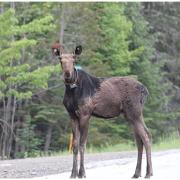
Maine’s Dynamic Moose Study: An Overview of Maine’s Seasonal Moose Research
Year round, Maine Department of Inland Fisheries and Wildlife biologists are going above via helicopters and beyond on ATVs, boats, snowmobiles and foot to implement several adaptive methods of population monitoring for Maine’s beloved and iconic mammal, the moose.
Managing for New England Cottontail in State Parks
By Wildlife Biologist Sarah Spencer
If you’re a regular reader of the MDIFW Blog, then you’re already familiar with the New England cottontail. If you’ve joined us more recently, welcome! Here’s a quick recap on some of the New England cottontail-themed blogs we’ve shared with you to date:
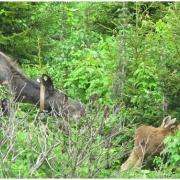
The Case of the Moose Spy
During calving season for moose, which runs from early May to early August when cows are weaning their calves onto a vegetarian and not solely milk-based diet, I have a group of spies in the woods.
Monitoring Maine's Peregrine Falcons
By Wildlife Promotional Coordinator Lauren McPherson
Recently, I had the opportunity to join one of my colleagues at the Maine Department of Inland Fisheries and Wildlife (MDIFW) in the field to do some monitoring of a peregrine falcon nesting site, as part of the Department’s ongoing statewide breeding monitoring program.
Keep In Touch!
Enter your email or mobile number to receive the latest news from MDIFW.